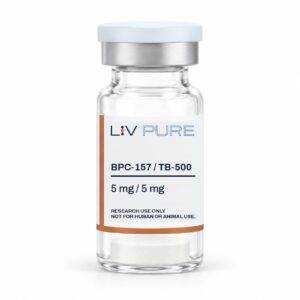
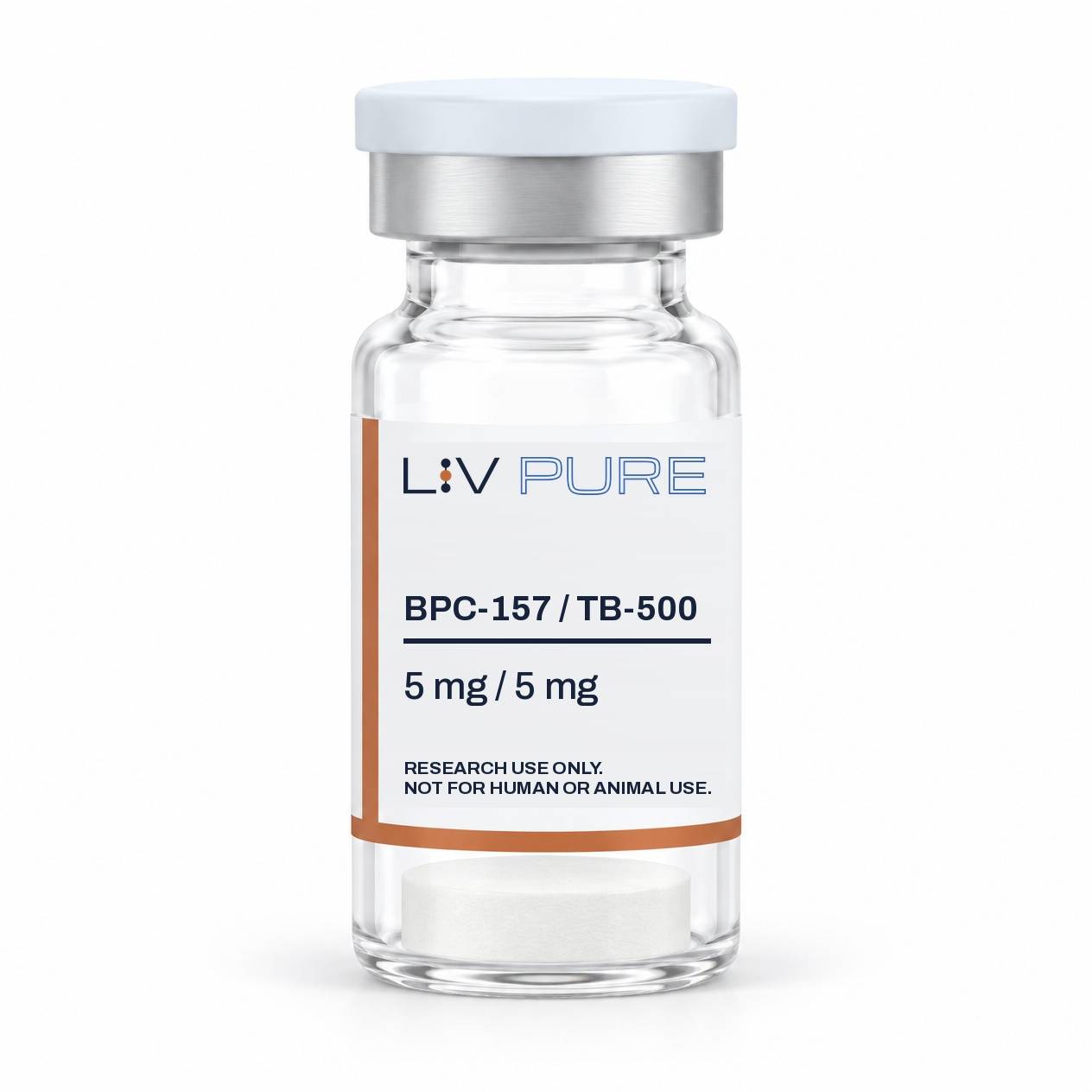
BPC-157 and TB-500 are two research peptides that are frequently compared. They are often mentioned together, but they are different molecules with different origins, sizes and studied pathways. This overview summarizes what the published preclinical literature has examined for each, side by side, with PubMed references.
Key takeaways
- BPC-157 is a synthetic 15-amino-acid peptide (1,419.5 g/mol) based on a fragment of a protein first described in gastric juice.
- TB-500 is a synthetic seven-amino-acid peptide, Ac-LKKTETQ, with a free-base mass near 889 g/mol, matching residues 17 to 23 of thymosin beta-4 with an acetylated N-terminus. It is a short-chain fragment, not the full-length 43-residue protein.
- BPC-157 studies have measured nitric oxide system and FAK-paxillin readouts. Most thymosin beta-4 studies used the full-length protein; published work on the isolated 17-23 motif is much smaller.
- Both literatures are mostly cell culture and animal models. Neither establishes safety or efficacy in humans.
What is the difference between BPC-157 and TB-500?
The two are unrelated sequences. BPC-157 is a 15-residue synthetic peptide with no known native protein function of its own. TB-500 is a seven-residue fragment, Ac-LKKTETQ, corresponding to the actin-binding motif of thymosin beta-4, a naturally occurring 43-residue protein found in nearly all mammalian cells. Their published literatures examine different molecular targets, so they are studied as two separate tools rather than two versions of the same thing.
BPC-157 vs TB-500 at a glance
| Property | BPC-157 | TB-500 (Ac-LKKTETQ) |
|---|---|---|
| Length | 15 amino acids | 7 amino acids |
| Sequence | Gly-Glu-Pro-Pro-Pro-Gly-Lys-Pro-Ala-Asp-Asp-Ala-Gly-Leu-Val | Ac-Leu-Lys-Lys-Thr-Glu-Thr-Gln-OH (Ac-LKKTETQ) |
| CAS number | 137525-51-0 | No single established registry number for the fragment |
| Molecular formula | C62H98N16O22 | C38H68N10O14 (free base) |
| Molecular weight | 1,419.5 g/mol | About 889 g/mol as the free base; a salt form would differ |
| Origin | Partial sequence of “body protection compound” isolated from human gastric juice | Residues 17 to 23 of thymosin beta-4, with the N-terminus acetylated |
| Main pathways studied | Nitric oxide system (eNOS), VEGFR2, FAK-paxillin | Actin binding and endothelial cell migration, measured mostly with the full-length parent protein |
| Typical model systems | Rat tendon explants and fibroblasts, rat vascular and wound models | HUVEC migration and aortic-arch sprouting assays; most other model work used the full-length protein |
| Main research group | Largely one group (University of Zagreb) | Several groups studied the parent protein; work on the fragment itself is mainly analytical chemistry |
| Form supplied | Lyophilized powder, 5 mg or 10 mg | Lyophilized powder, 5 mg or 10 mg |
What is BPC-157?
BPC-157 is a synthetic pentadecapeptide whose sequence is a partial fragment of “body protection compound,” a protein described in human gastric juice. It is notable among research peptides for being stable in aqueous solution, which is one reason it is used as a reference compound in cytoprotection assays.
Pathways examined in BPC-157 research
- FAK-paxillin signaling. In cultured rat Achilles tendon fibroblasts, BPC-157 increased cell spreading, migration and survival under oxidative stress, along with concentration-dependent phosphorylation of FAK and paxillin (Chang et al., 2011).
- Nitric oxide system. In a rat isoprenaline model, observed effects were reported alongside changes in eNOS and COX2 gene expression and interaction with the NOS blocker L-NAME (Barisic et al., 2022).
- Vascular response. A review of rat vascular injury models describes interactions with NO, VEGF and FAK pathways (Seiwerth et al., 2014).
A limitation worth noting: much of the BPC-157 literature comes from a single research group in Zagreb, and no single high-affinity receptor for BPC-157 has been identified.
What is TB-500?
“TB-500” is the name used in the research-peptide market for the N-acetylated 17-23 fragment of thymosin beta-4, sequence Ac-LKKTETQ. Doping-control laboratories identified this heptapeptide as the key ingredient of products marketed under that name. Esposito et al. (2012) characterized it by high-resolution mass spectrometry and resynthesized it; Ho et al. (2012) reported an LC-MS method for detecting it. Liv Pure’s TB-500 is this short-chain fragment. A 2026 review notes that TB-500 is frequently conflated with the full-length protein although no biological equivalence between the two has been established (Tham et al., 2026), so it is worth knowing which molecule a vial is declared to contain. Note what a certificate of analysis can and cannot show: an HPLC-UV report measures chromatographic purity, not sequence or mass, so molecular identity rests on the supplier declaration unless a mass-spectrometry identity test is run.
What has been measured for the parent protein and for the 17-23 motif
- Actin sequestration. Thymosin beta-4 binds monomeric G-actin with micromolar affinity, allowing fast binding and release. It is the main G-actin-sequestering peptide in most vertebrate cells (Hannappel, 2007).
- Endothelial cell migration. In Boyden chamber assays, thymosin beta-4 increased directional migration of human umbilical vein endothelial cells four- to sixfold over medium alone (Malinda et al., 1997).
- The 17-23 motif itself. Philp et al. (2003) compared synthetic peptides in HUVEC migration and chick aortic-arch sprouting assays and reported that the seven-residue actin-binding motif and the full-length protein were active at similar concentrations, while peptides missing part of the motif were not. Sosne et al. (2010) reviewed the activities attributed to short thymosin beta-4 sequences, including the N-terminal Ac-SDKP region.
- Cardiac models (parent protein). A review of preclinical cardiac work describes the measurements reported for full-length thymosin beta-4 and the SRF-MRTF-G-actin pathway (Pipes and Yang, 2016).
Do BPC-157 and TB-500 act on the same pathway?
No. The published literature places them on different pathways. BPC-157 studies point to the nitric oxide system and FAK-paxillin signaling. Thymosin beta-4 studies point to actin binding and cytoskeletal dynamics, mostly using the full-length protein rather than the TB-500 fragment. Because the mechanisms are distinct, some laboratories study both compounds in the same model to compare or combine readouts. We are not aware of a peer-reviewed study that tested the two peptides together as a single preparation.
Where does the evidence stop?
- Nearly all published work on both compounds is in vitro or in animals (mainly rats and mice).
- Findings in rodent injury models do not establish safety, efficacy or any effect in humans.
- Neither compound is approved by the FDA for any use. Both are sold by Liv Pure for laboratory research only.
Sourcing and verifying research material
For either peptide, the certificate of analysis is the starting point. Check that the compound, size and HPLC purity on the certificate match the material ordered, and that the lot number on the certificate matches the lot printed on the vial. Liv Pure posts current certificates on the Certificates of Analysis page. Lyophilized powder is stored sealed at 2 to 8 °C for short-term holding and at -20 °C for long-term storage, protected from light and moisture.
Liv Pure research materials referenced in this article:
- BPC-157 (5 mg and 10 mg)
- TB-500 (5 mg and 10 mg)
- BPC-157 / TB-500 Blend (both peptides in one vial)
- KLOW Blend and Glow Blend, which include both alongside GHK-Cu
More compounds in this class are covered in the Tissue-Repair Peptides section of the Research Library.
Frequently asked questions
Is TB-500 the same as thymosin beta-4?
No. TB-500 is the N-acetylated 17-23 fragment of thymosin beta-4, Ac-LKKTETQ, seven amino acids with a free-base mass near 889 g/mol. Full-length thymosin beta-4 is a 43-residue protein of about 4,963 g/mol. The two names are often conflated. An HPLC-UV certificate of analysis reports purity rather than sequence or mass, so the molecular weight, sequence and salt form on a label are a supplier declaration, and distinguishing the 889 g/mol fragment from the roughly 4,963 g/mol protein requires a mass-spectrometry identity test.
Which is larger, BPC-157 or TB-500?
BPC-157 is larger. It has 15 amino acids and weighs 1,419.5 g/mol, while TB-500 has seven amino acids and a free-base mass near 889 g/mol. Full-length thymosin beta-4, a different molecule, is heavier than both.
What receptor does BPC-157 bind?
No single high-affinity receptor has been established. Published studies describe effects on the nitric oxide system, VEGFR2 and FAK-paxillin signaling.
What does thymosin beta-4 bind?
Full-length thymosin beta-4 binds monomeric G-actin. Its central actin-binding motif is LKKTETQ, residues 17 to 23, which is the sequence supplied as TB-500.
Have BPC-157 or TB-500 been proven in humans?
No. The published research is predominantly cell culture and animal studies, and neither compound is FDA approved. Liv Pure sells both for laboratory research use only, not for human or veterinary use.
Why is a BPC-157 / TB-500 blend offered?
Because the two peptides are studied on distinct pathways, some laboratories use both in the same experimental model. The blend supplies both research materials in one vial. It is not a formulation for any human or veterinary use.
References
- Chang CH, Tsai WC, Lin MS, Hsu YH, Pang JH. The promoting effect of pentadecapeptide BPC 157 on tendon healing involves tendon outgrowth, cell survival, and cell migration. J Appl Physiol. 2011;110(3):774-80. PMID 21030672. doi:10.1152/japplphysiol.00945.2010
- Barisic I, et al. Stable gastric pentadecapeptide BPC 157 may counteract myocardial infarction induced by isoprenaline in rats. Biomedicines. 2022;10(2):265. PMID 35203478. doi:10.3390/biomedicines10020265
- Seiwerth S, et al. BPC 157 and blood vessels. Curr Pharm Des. 2014;20(7):1121-5. PMID 23782145. doi:10.2174/13816128113199990421
- Seiwerth S, et al. Stable gastric pentadecapeptide BPC 157 and wound healing. Front Pharmacol. 2021;12:627533. PMID 34267654. doi:10.3389/fphar.2021.627533
- Hannappel E. beta-Thymosins. Ann N Y Acad Sci. 2007;1112:21-37. PMID 17468232. doi:10.1196/annals.1415.018
- Malinda KM, Goldstein AL, Kleinman HK. Thymosin beta 4 stimulates directional migration of human umbilical vein endothelial cells. FASEB J. 1997;11(6):474-81. PMID 9194528. doi:10.1096/fasebj.11.6.9194528
- Malinda KM, et al. Thymosin beta4 accelerates wound healing. J Invest Dermatol. 1999;113(3):364-8. PMID 10469335. doi:10.1046/j.1523-1747.1999.00708.x
- Sosne G, Qiu P, Goldstein AL, Wheater M. Biological activities of thymosin beta4 defined by active sites in short peptide sequences. FASEB J. 2010;24(7):2144-51. PMID 20179146. doi:10.1096/fj.09-142307
- Pipes GT, Yang J. Cardioprotection by thymosin beta 4. Vitam Horm. 2016;102:209-26. PMID 27450736. doi:10.1016/bs.vh.2016.04.004
- Philp D, Huff T, Gho YS, Hannappel E, Kleinman HK. The actin binding site on thymosin beta4 promotes angiogenesis. FASEB J. 2003;17(14):2103-5. PMID 14500546. doi:10.1096/fj.03-0121fje
- Esposito S, Deventer K, Goeman J, Van der Eycken J, Van Eenoo P. Synthesis and characterization of the N-terminal acetylated 17-23 fragment of thymosin beta 4 identified in TB-500, a product suspected to possess doping potential. Drug Test Anal. 2012;4(9):733-8. PMID 22962027. doi:10.1002/dta.1402
- Ho EN, Kwok WH, Lau MY, Wong AS, Wan TS, Lam KK, Schiff PJ, Stewart BD. Doping control analysis of TB-500, a synthetic version of an active region of thymosin beta 4, in equine urine and plasma by liquid chromatography-mass spectrometry. J Chromatogr A. 2012;1265:57-69. PMID 23084823. doi:10.1016/j.chroma.2012.09.043
- Tham A, Hodgkins CW, Kennedy JG. Investigational peptides in orthopaedic practice: evidence, safety, and patient counseling for BPC-157, thymosin beta-4, and TB-500. J Am Acad Orthop Surg. 2026. PMID 42937313. doi:10.5435/JAAOS-D-26-00049
References retrieved and verified through PubMed. Last reviewed November 2026.
For research use only. Not for human or veterinary use, and not for human consumption. Liv Pure products are sold to qualified researchers 21 and older for in-vitro and laboratory research. Nothing in this article is medical advice or a claim that any compound diagnoses, treats, cures or prevents any condition. These statements have not been evaluated by the FDA.