BPC-157 is one of the most-searched research peptides, and also one of the most misunderstood. This article summarizes what the published laboratory and animal literature has actually examined, which models and pathways it has used, and where the evidence stops.
Key takeaways
- BPC-157 is a synthetic 15-amino-acid peptide (sequence GEPPPGKPADDAGLV) derived from a protein fragment originally isolated from gastric juice.
- The literature is predominantly preclinical: cell culture and rat injury models, much of it from a single research group.
- Studies have focused on the nitric oxide system, VEGFR2 and FAK-paxillin signaling; no single high-affinity receptor has been established.
- These studies do not establish safety or efficacy in humans.
What BPC-157 is
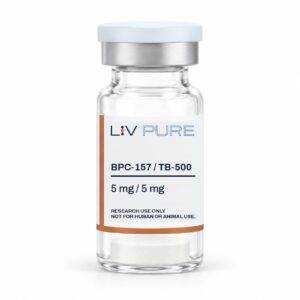
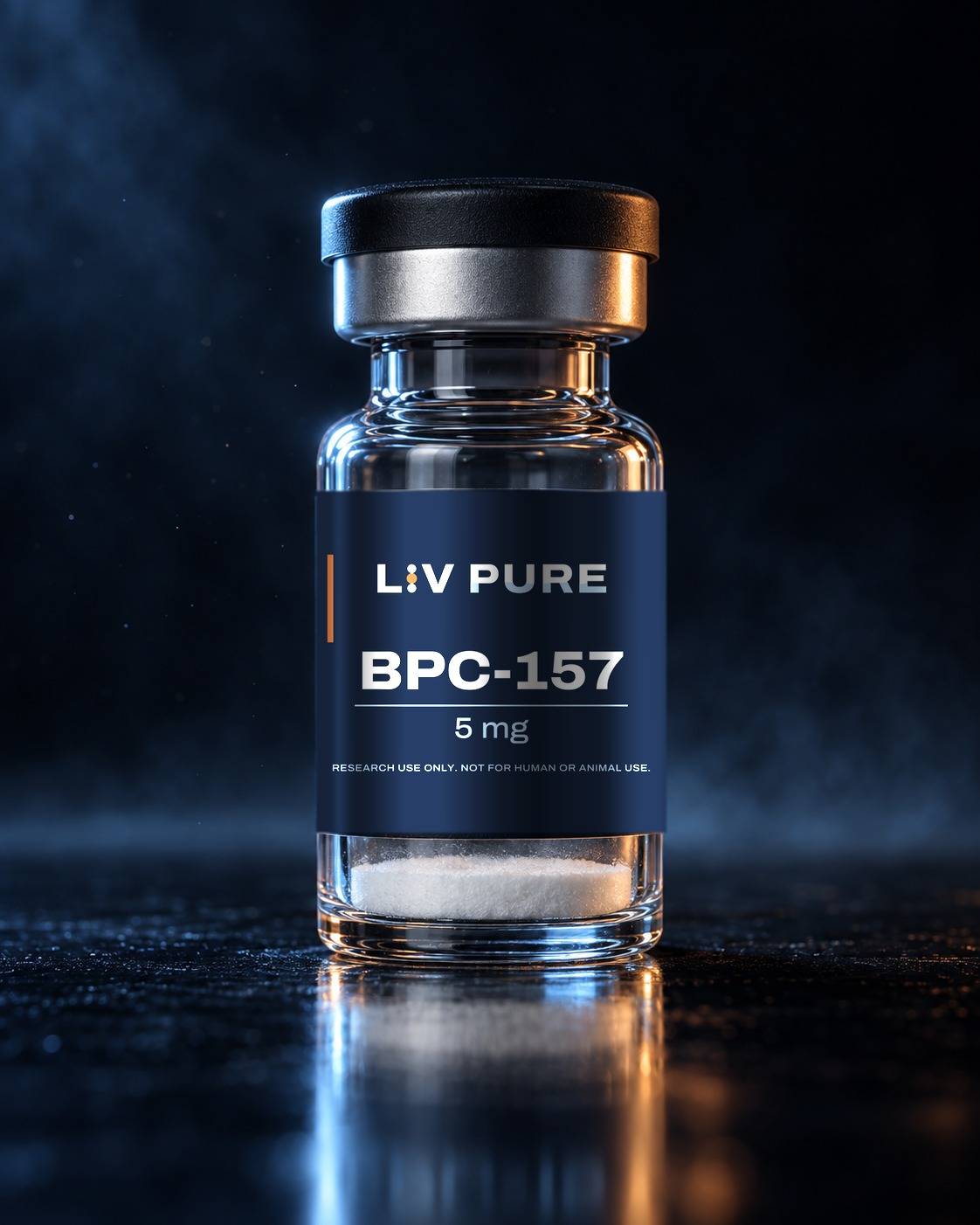
BPC-157 (“Body Protection Compound-157”, also catalogued as PL 14736) is a synthetic pentadecapeptide, molecular weight about 1419 g/mol. It corresponds to a partial sequence of a protein first isolated from human gastric juice. Research-grade material is produced by solid-phase synthesis and supplied as a lyophilized powder.
Which pathways researchers have studied
- Nitric oxide (NO) system: many rat studies report interactions with eNOS and responses that change with L-NAME or L-arginine co-administration.
- VEGFR2 signaling: in cultured human vascular endothelial cells, BPC-157 was associated with increased VEGFR2 expression and internalization and activation of VEGFR2-Akt-eNOS signaling (Hsieh et al., 2017).
- FAK-paxillin pathway: activation was observed in cultured rat tendon fibroblasts in migration assays.
- Gene expression: changes in eNOS and COX2 expression have been reported in rat models.
Model systems used
In-vitro work includes rat Achilles tendon explants, tendon fibroblast migration and survival assays, human vascular endothelial cell cultures, and membrane-potential measurements in HEK293 cells. In-vivo work is concentrated in rat injury models (see the references below).
Selected published studies
The references below are the preclinical subset collected in the Liv Pure Research Library. Each links to its PubMed record.
- Chang CH et al. (2011), J Appl Physiol. Rat Achilles tendon explants and cultured rat tendon fibroblasts. Measured explant outgrowth, fibroblast proliferation, migration and survival under oxidative stress, and FAK and paxillin phosphorylation. PMID 21030672 · DOI
- Seiwerth S et al. (2014), Curr Pharm Des. Review of BPC-157 and blood vessels, largely rat studies; discusses proposed NO, VEGF and FAK pathway involvement. PMID 23782145 · DOI
- Zivanovic-Posilovic G et al. (2016), Eur J Pharmacol. Membrane-potential measurements in HEK293 cells and ECG recordings in a rat bupivacaine model. PMID 27815173 · DOI
- Seiwerth S et al. (2021), Front Pharmacol. Review of rat skin-model studies, including gene-expression measurements in rat excisional models. PMID 34267654 · DOI
- Barisic I et al. (2022), Biomedicines. Rat isoprenaline model. Measured cardiac necrosis markers, oxidative-stress parameters and eNOS and COX2 gene expression, with L-NAME and L-arginine comparisons. PMID 35203478 · DOI
- Hsieh MJ et al. (2017), J Mol Med. Chick chorioallantoic membrane and endothelial tube-formation assays, human vascular endothelial cells and a rat hind-limb ischemia model. Measured vessel density and VEGFR2 expression, internalization and VEGFR2-Akt-eNOS signaling. PMID 27847966 · DOI
What recent reviews say
Two systematic reviews summarize where the literature stood by mid-2026. A 2025 review in HSS Journal screened 544 records and included 36 studies, 35 of them preclinical, and found no clinical safety data (Vasireddi et al., 2025). A 2026 systematic review found three small, uncontrolled human reports with 30 participants in total, judged them to be of poor methodological quality, and rated the overall certainty of evidence as very low (Poolton et al., 2026).
- Vasireddi N et al. (2025), HSS J. Systematic review, 36 studies (35 preclinical). PMID 40756949 · DOI
- Poolton JT, Minett J, Kazmi A (2026), Acta Orthop Belg. Systematic review of human reports, 3 studies, certainty rated very low. PMID 42885452 · DOI
Limits of the evidence
Three points are worth stating plainly. First, most of the literature comes from one research group, so independent replication is limited. Second, the work is overwhelmingly in rats and cultured cells, and the few human reports are small and uncontrolled. Third, no specific receptor has been identified, so mechanistic claims remain proposals. None of these studies establishes safety or efficacy in humans, and BPC-157 is not an approved drug.
Working with BPC-157 in the lab
Match the lot number on the vial to its certificate of analysis, store sealed vials at 2 to 8 °C short-term or −20 °C long-term, and prepare stock solutions according to the assay method (see our storage guide). Liv Pure supplies BPC-157 as a lyophilized research reagent; current certificates are posted by lot on the Certificates of Analysis page.
Frequently asked questions
Is BPC-157 a natural peptide?
It is a synthetic peptide whose sequence corresponds to part of a protein isolated from human gastric juice. Research material is manufactured by chemical synthesis.
What is BPC-157’s molecular weight?
About 1419 g/mol for the 15-residue sequence GEPPPGKPADDAGLV.
Has BPC-157 been approved for human use?
No. It is not an approved drug, and Liv Pure supplies it strictly for laboratory research.
References retrieved and verified through PubMed. Last reviewed November 2026.
All Liv Pure products are supplied for laboratory research use only. Not for human consumption, and not for human or animal use. Not for diagnostic, therapeutic or cosmetic purposes. Sold only to purchasers 21 and older.